
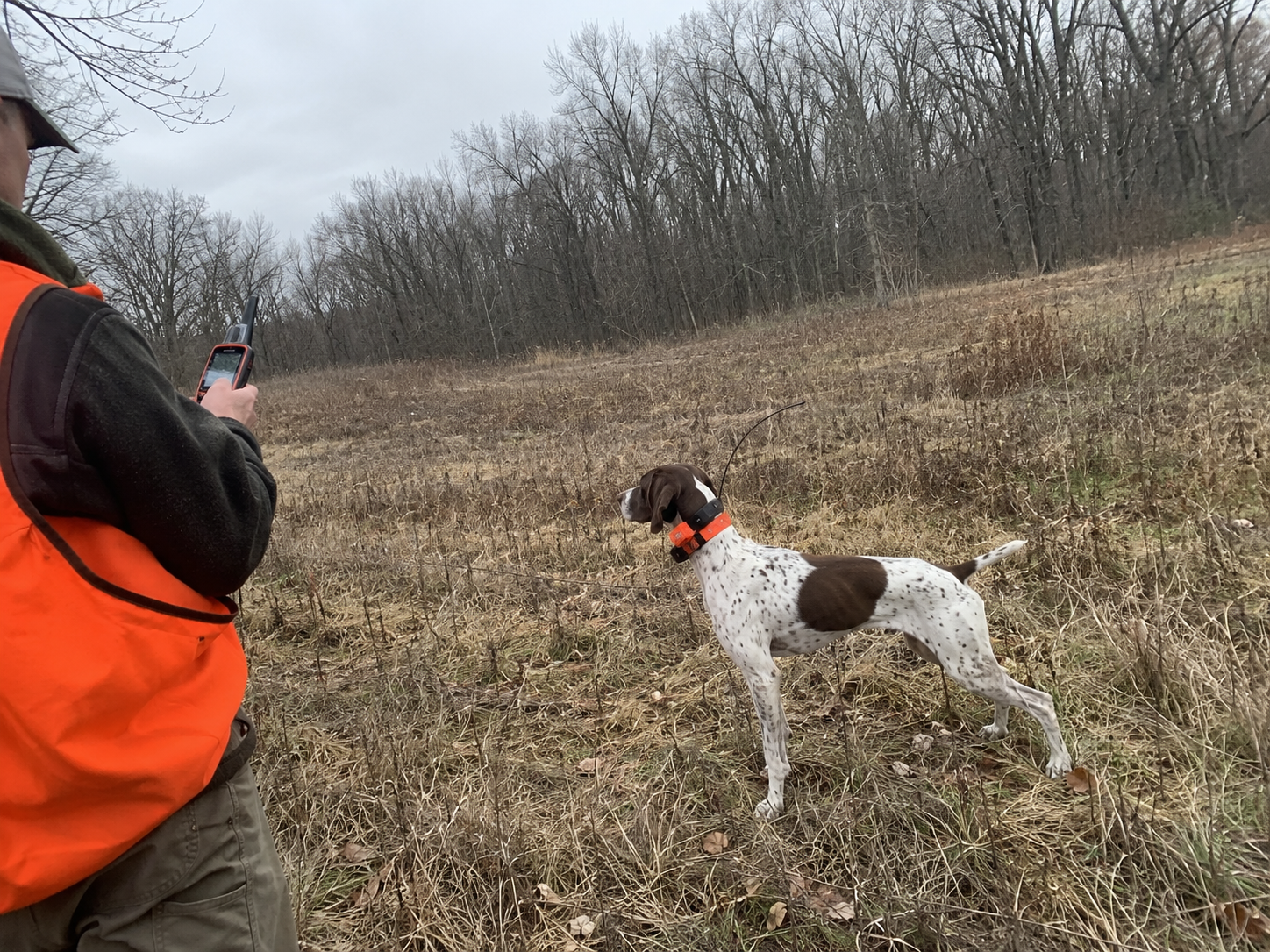
What the Garmin Alpha TT 25 is
The Garmin Alpha TT 25 is a radio tracking and training collar. It sends your dog’s position by VHF radio to an Alpha handheld that you carry. There is no cell network involved, so it works where a phone-based tracker would have no signal. You see your dog’s direction and distance on the handheld, and you can send tone, vibration or stimulation cues.
It is built for hunters and people who work dogs in open country. It has no GPS fence. The handheld can sound a proximity alarm when your dog leaves a set area, but nothing keeps a dog inside a boundary. See how it compares with the rest on the comparison page.
What you really pay: the handheld
The collar alone is $350 at list price on . A dealer sale of $299.99 appeared in an earlier listing, but list is the safer figure.
The collar does not work on its own. It needs an Alpha handheld, which Garmin sells separately. The Alpha 300 handheld lists at $799.99. Add the two and the system comes to $1,150. One reviewer’s caption put a handheld plus one collar at about $1,300, which we could not verify, and retailer bundles are reported at around $1,000 and up, so shop around.
| Item | Price | Notes |
|---|---|---|
| TT 25 collar alone | $350 | Needs a handheld |
| Alpha 300 handheld | $799.99 | Required, sold separately |
| Collar plus handheld | $1,150 | No yearly plan for radio tracking, but see below |
If you already own an Alpha handheld, the collar is the only cost. A handheld works with all Alpha collars, according to a reviewer.
Check price at Garmin We may earn a commission from this link.Is there a plan?
Radio tracking with the TT 25 appears to carry no subscription. One spec aggregator says none is required, and no transcript or review we found mentions a fee. Garmin’s own page was not confirmed, so that is low confidence. The separate Garmin Alpha LTE collar has a cellular plan of $49.99 a year. That plan applies to Garmin’s LTE collars, and it is not confirmed for the TT 25. Check Garmin’s page before you buy.
Range and coverage
Garmin rates the radio at up to 9 miles. That is a maker claim, and the real range depends on terrain. One independent range test, from a truck, reached about 2.35 to 3.6 miles for the Garmin and another brand, short of the claim. One owner reported losing the signal over a hill, which fits how VHF radio works: it needs a clear line of sight.
Treat 9 miles as a best case in open, flat country. In rolling or wooded ground, plan on far less, and keep within the range where you can still see your dog’s movement on the handheld.
What it gets right
No cell and no plan. For most radio tracking, you pay once. If you hunt where cell coverage is thin, that is the main reason to pick a radio system. The guide to how trackers work explains the difference.
Track and train in one collar. The TT 25 has 18 vibration levels and stimulation. One owner reported that stimulation still worked after tracking dropped out.
Long battery for a tracking collar. Garmin’s spec gives 68 hours on the standard pack and 136 hours on the extended pack in dynamic tracking. An owner reported about two days between charges with normal use, which is the figure to plan around.
Repairs are possible. Flex bands and antenna covers can be replaced by the owner. A short flex band is sold separately, though one owner said it is only worth it for necks under about 15 inches.
Where it falls short
The real cost is the handheld. The collar price is the small part. If you only budget for the collar, you will come up short.
Range claims are untested. The 9 mile claim should not be taken as fact. One test fell short, and a hill ended the signal for one owner.
Battery figures vary. Listings give 68, 84 and 25 hours, depending on the update rate. The update rate ranges from 2.5 seconds to 2 minutes, and faster updates use more battery.
Connector corrosion. A repair shop calls it the biggest failure. Cleaning and grease help, and it is worth buying a spare charging clip.
Weight and dog size are not published. We found no dog weight limit and no collar weight. If you have a small dog, check the collar against your dog’s neck before you commit.
One report of crossed signals. In a single Reddit report from November 2026, an owner described ID jumping and a correction reaching the wrong dog with an Alpha 300 and a TT 25. That is one report, but if you run several dogs, ask Garmin about it first.
Track, train and the T 20
The TT 25 is the track-and-train version. One reviewer describes it as tone, vibration and stimulation together, while the T 20 is the same unit without stimulation. If you want tracking and tone or vibration only, that difference matters, since you would not pay for a feature you do not plan to use. If you compete or hunt under organized rules, read your event’s rulebook on collars before you buy, since rules differ from place to place.
Care and durability
A collar that works in the field takes some upkeep. A repair shop says connector corrosion is the most common failure. Its advice is contact cleaner, a soft brush and dielectric grease, with a check once or twice a year. A spare charging clip is cheap insurance, and firmware updates come over Wi-Fi. A search summary lists the collar at 1 ATM (10 m) for water, and we found no independent dunk test. Corrosion is a contact problem, so rinse the collar after muddy or wet trips and dry the contacts before you charge it. If you work your dog in water often, read the waterproof tracker guide for what the ratings mean.
What owners report
We found little owner feedback on the TT 25 in public threads, so we cannot give a pattern. The few reports are about range over hills, battery lasting about two days, connector corrosion and the one ID report above.
What the maker says and what reviewers reported
| Garmin says | Reviewers and owners | |
|---|---|---|
| Range | Up to 9 miles | About 2.35 to 3.6 miles in one truck test; lost over a hill for one owner |
| Battery | 68 hours standard, 136 hours extended pack | About 2 days with normal use |
| Waterproofing | 1 ATM (10 m) | No independent test found |
| Plan | Not confirmed on Garmin’s page | One aggregator says none |
We have not tested the collar ourselves. These are other people’s measurements and claims.
Who should not buy it
- Owners who only want to spend the price of a collar.
- Owners who want a GPS fence.
- Owners who want their dog’s location on a phone from anywhere.
- Owners who run several dogs and cannot risk crossed corrections.
If you want a phone-based tracker with no handheld, the Tractive DOG 6 costs $403 over three years. Other no-plan options are on the page for trackers with no subscription. To see how a radio system fits against the cost of a plan, read what a GPS collar costs.