
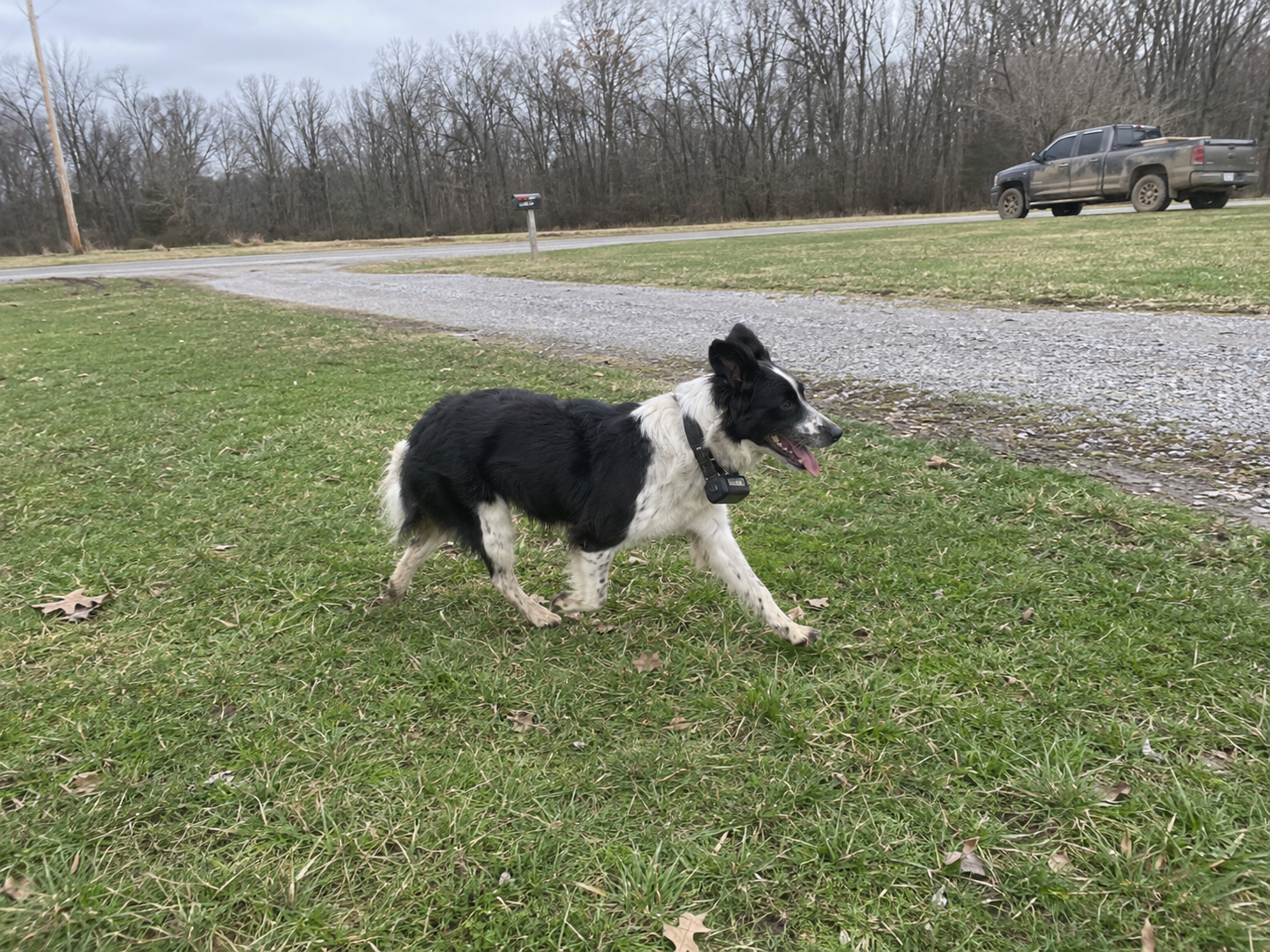
What a GPS dog fence is
A GPS dog fence is a boundary stored in your dog’s collar. The collar tracks its own position by satellite and warns your dog with a tone, then vibration, then an optional static correction as it nears the line. There is no wire to bury and no transmitter in the house.
Which model fits depends on three things: your yard, your dog’s weight and whether you will pay a monthly plan. Halo suits an open yard if you accept a plan. SpotOn suits owners who want no plan and a dog of 15 lb or more. PetSafe Guardian GPS 2.0 suits a dog from 10 lb that also needs tracking. Compare every GPS dog collar if you are still deciding between a fence and a tracker.
Check price at Halo We may earn a commission from this link.Fence types and their limits
There are three common ways to build a pet boundary without a fence panel. Each one fails differently, which matters more than which is newest.
Wireless radio fence. A transmitter in the house sends a circle of signal and the collar reacts at the edge. It is simple, but the shape is always a circle and trees or walls can distort it. Product details for radio fences are outside what this page covers.
GPS virtual fence. The collar knows where it is and where the line is. You can shape the boundary freely and cover a larger area. The limit is GPS itself: tall trees, buildings and hills reduce accuracy.
In-ground wire. A buried wire sends a signal along a fixed line. It does not drift with GPS, but you have to dig, and a break in the wire stops it working.
This page covers the GPS type only.
The three GPS fence collars compared
Three-year cost of each GPS fence collar
Prices checked
| Collar | Tags | 3-year cost (device + plan)3-year cost | Total | Specs |
|---|---|---|---|---|
| PetSafe Guardian GPS 2.0 Fence and tracker Fence | Fence | $450 device + $297 plan | $747 | |
| Halo Collar 5 Fence collar Fence | Fence | $599 device + $360 plan | $959 | |
| SpotOn (fence only) Fence collar, no plan Fence · No plan | Fence, No plan | $999 device | $999 | |
| SpotOn Virtual Smart Fence Fence collar Fence | Fence | $999 device + $306 plan | $1,305 |
Tap a collar name for full specs.
| Halo Collar 5 | SpotOn | PetSafe Guardian GPS 2.0 | |
|---|---|---|---|
| How you set the line | Draw it on a map in the app | Walk the boundary with the collar | Set in the app |
| Minimum dog weight | 10 lb | 15 lb | 10 lb |
| Correction | Tone, vibration, static | Tone, vibration, optional static | Tone, vibration, 10 static levels |
| Needs a plan | Yes, for the collar to work | No for the fence, yes for tracking | Plan terms for the fence not confirmed |
| Open yard suggested | About 900 sq ft in one review | Half an acre, or about a third in some reviews | Half to three quarters of an acre of open ground |
The minimums are the makers’ figures. They are not the result of any fit test.
Halo Collar 5
Halo lets you draw the fence on your phone and change it later, and it adds Bluetooth beacons for indoor keep-away zones. The collar costs $599 at list price, and the cheapest plan adds $120 a year on monthly billing. That makes $959 over three years. Battery is the usual complaint: Halo claims up to 48 hours and reviewers saw about 24 to 48. Read the full Halo review for plans and owner themes.
SpotOn
SpotOn is the one fence collar here that works with no plan. You walk the boundary with the collar to record it, and the fence then runs with no cell or Wi-Fi. Tracking, escape reports and manual feedback need a plan. The fence alone is $999, and with the tracking plan the three-year total is $1,305. The minimum dog weight is 15 lb and the neck must measure at least 10 inches. See the SpotOn review for detail.
Check price at SpotOn We may earn a commission from this link.PetSafe Guardian GPS 2.0
PetSafe sells a fence and tracker collar for dogs of 10 lb and up, with tone, vibration and 10 static levels. The collar is $450 with a plan of $99 a year, or $747 over three years. Retailer figures for neck size conflict, and it is not clear whether the fence works without the plan, so confirm both before you buy. The PetSafe review lists the open questions.
Cost by year
| Year 1 | Year 2 | Year 3 | |
|---|---|---|---|
| Halo Collar 5 | $719 | $839 | $959 |
| SpotOn with tracking plan | $1,101 | $1,203 | $1,305 |
| SpotOn fence only | $999 | $999 | $999 |
| PetSafe Guardian GPS 2.0 | $549 | $648 | $747 |
Totals use list prices checked on . Halo showed the collar at $419 as a sale with no end date, but sales end, so the table uses list. Each extra dog needs its own collar and, where a plan applies, its own plan.
How accurate is a GPS fence
Makers and reviewers disagree, so keep them apart.
| Source | Method | Result |
|---|---|---|
| Halo, maker claim | Not stated | Accurate to within 2 feet |
| SpotOn, maker claim | Not stated | About 40% less drift than Halo |
| One independent reviewer | Rope test, five trials per collar | SpotOn about 8 inches average drift, Halo about 25 inches, Halo with a far wider spread |
| The same reviewer | 51 passes per collar | SpotOn gave a correct early warning 48 times (about 94%), Halo 33 times (about 65%) |
| A second reviewer | Near trees and a road | SpotOn drifted 3 to 6 feet, Halo 6 to 10 feet |
| One independent reviewer | Dense canopy, five trials | PetSafe Guardian gave no feedback in 2 of 5 trials |
Read those with care. They are small tests, and the numbers cover only the products each reviewer chose. The same channel’s dense-canopy result for SpotOn flips between two videos, so a good result in the open does not guarantee one under trees. SpotOn also cites a lab test it funded that reported full reliability, which is a claim from the maker’s side. Trees degrade every brand that was tested.
Will it work on your property
Flat, open yards give a GPS fence the best chance. A clear view of the sky matters more than the size of the lot.
Trees. Dense canopy is the main cause of weak fixes. Place the line well inside the trees rather than through them.
Hills. We found no reviewer test on steep or hilly ground, so we cannot say how any of these collars behave there.
Small lots. Reviewers suggest at least about 900 square feet for Halo and about a third to half an acre for SpotOn. Keep narrow passages about 30 feet wide, because a corridor thinner than the drift becomes a dead zone.
Training and setup
Plan on a few days to two weeks of short sessions, about 10 to 15 minutes each. A common order is tone first, then vibration, then static only if you decide to use it. Reviewers also suggest proofing the dog against 10 to 15 distractions before you leave it alone in the yard, such as a thrown ball, a passing person or a squirrel.
Before you start, walk your property and note where trees, buildings and slopes sit. Plan the line so that the dog’s warning zone ends well before any hazard, and charge the collar fully before every session, because a collar that dies mid-afternoon is no fence at all. Battery claims are short for fence collars: Halo claims up to 48 hours, SpotOn 22 to 35 hours, and PetSafe up to 70 hours. Owners and reviewers saw roughly a day to two days in practice, so most households charge every night or two.
A fence is a training tool, not a promise. Dogs that learn the line stay in. Dogs with a strong chase drive can still decide the correction is worth it.
A fence is not a tracker
Only some of these collars also track your dog. Halo and PetSafe Guardian include cellular tracking with the plan. SpotOn tracks only if you pay for its plan. None of them replaces a tracker for a dog that escapes: the collar is built to warn at a line, not to find a dog that is already gone. If an escaped dog is your main worry, see the GPS dog collar comparison and the guide to finding a lost dog.
What vets and veterinary bodies say
Veterinary bodies are wary of electronic correction. The Canadian Veterinary Medical Association strongly discourages shock collars for remote training, while calling non-remote collars used for fencing provisionally acceptable under some circumstances (position dated 2021). The British Veterinary Association calls for a ban on the sale and use of electronic shock collars. Regulations were laid in England in April 2023, and we could not confirm that they are in force. We found no United States veterinary statement we could read in full. If you are unsure, talk to your vet or a qualified trainer before you use static correction. You can leave static off and use tone and vibration alone on collars that allow it.
Also considered
SatelliAI Go is sold as a fence and tracker. Two independent tests saw no fence feedback within about 30 feet in dense canopy, while sponsored reviews say it works, so we do not recommend it on this evidence. Pawious appears only in its own claims. Aorkuler is a tracker, not a fence. For small dogs, see fences for small dogs.