
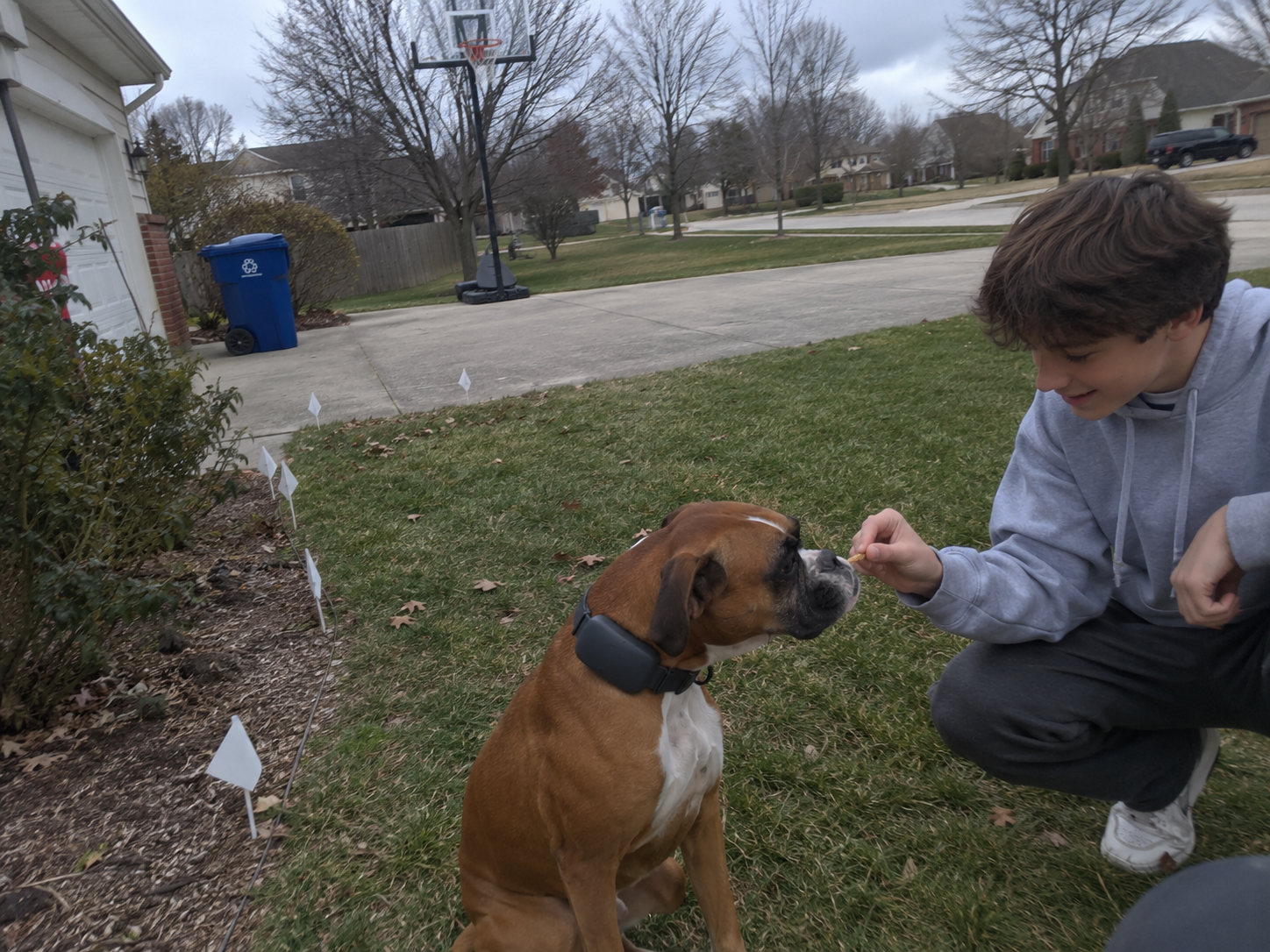
What the Halo Collar 5 is
The Halo Collar 5 is a GPS fence collar. You draw a boundary on a map in the Halo app, and the collar warns your dog with a tone, then vibration, then an optional static correction when it gets close to the line. The same collar also shows your dog’s location on your phone over the mobile network, so it doubles as a tracker.
It suits owners who want a fence without digging a wire, on a property large and open enough for GPS to work well. It is not the right pick if you want to pay once and be done: the collar needs a paid plan to work at all.
What it gets right
The fence is easy to set and change. You draw it on your phone instead of walking the line, and you can save several fences, for example home and a holiday cabin. Bronze allows 5 fences, Silver 20 and Gold unlimited.
Fence, tracking and training in one collar. Many owners buy a fence and a tracker separately. Halo combines both, and adds training cues (tone, vibration and static) you can use around the house and on walks.
Indoor keep-away zones. Small Bluetooth beacons let you block off rooms or the bin, which a plain GPS fence cannot do because GPS is weak indoors.
Owners say dogs learn the line. In owner discussions, people who stuck with the training report that their dogs learned where the boundary is, and a few praised fast replacements when a collar failed.
Where it falls short
It only works with a plan. Reviewers report that the collar stops working without a paid subscription. That turns a $599 device into an ongoing bill: Bronze alone adds $360 over three years.
Battery life is short. Halo claims up to 48 hours. Independent reviewers saw anywhere from about 24 to 48 hours, and one owner reported charging it every day. Plan to charge it most nights.
The fence is drawn, not walked. Because the line comes from a map, any error in the map or in the GPS fix shows up at the boundary. One reviewer found a fence line about 20 feet off. You cannot correct it by walking the line with the collar.
Firmware and support complaints. In a small set of owner threads from mid 2026, owners described false corrections after a firmware update and slow communication from the company. That is a small sample, but it is a pattern worth knowing about.
What owners report
Owner feedback comes from a small number of public threads, so read it as themes rather than statistics:
- Reported often: frequent charging, false corrections after updates, drift in built-up areas, and the cost of plans for several dogs (one owner paid $39.99 a month for three collars).
- Reported less often: boundary warnings that arrive late, and the app needing a restart.
- Praised: dogs learning the boundary within a couple of weeks, and quick replacement collars.
What the maker says and what reviewers measured
| Halo says | Independent reviewers | |
|---|---|---|
| Battery | Up to 48 hours | About 24 to 48 hours |
| Fence accuracy | Within 2 feet | About 25 inches average drift in one rope test, with a wide spread |
| Warning tone | Before every correction | First tone missed in 2 of 5 trials in one test |
| Waterproofing | No IP code published | IP67 according to one outdoor review |
We have not tested the collar ourselves. These are other people’s measurements, and they vary with trees, buildings and how the fence is drawn.
Will it work on your property?
GPS fences work best on open, flat ground with a clear view of the sky. Expect the boundary to wander more under tall trees, next to houses and in tight suburban lots. Keep the line well inside your property and well away from roads, because no GPS fence is exact enough to rely on next to traffic. On a small city lot, a physical fence or supervised time outside is usually the safer choice.
Halo Collar 5 vs Halo Collar 4
The Halo 5 is the current model. Halo describes faster location updates and separate Wi-Fi and Bluetooth chips compared with the Halo 4, but we have no independent side-by-side test of the two. If you find a Halo 4 at a large discount, check that it is still supported by the app and that the same plans apply before you buy.
Who should not buy it
- Owners who do not want a monthly bill for the life of the collar.
- Owners of dogs under 10 lb.
- Anyone whose boundary runs close to a busy road.
- Owners who cannot charge a collar every day or two.
If you want a GPS fence without a plan, the SpotOn fence keeps working with no subscription, though it costs more to buy. If you mostly want to know where your dog is, a tracker such as Fi Series 3+ costs $567 over three years.